Dog-Eared and Decanted: The Bookshelf That Belongs to Everyone
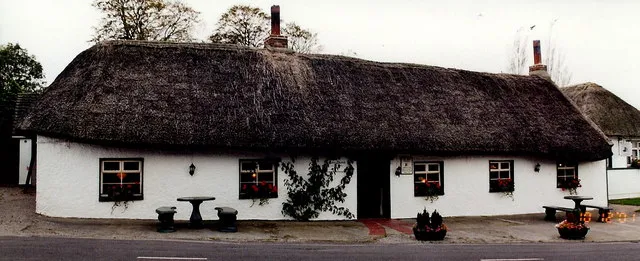
Photo: Joseph Mischyshyn, CC BY-SA 2.0, via Wikimedia Commons
There is a particular sound a cider house makes on a wet Tuesday in November. The fire ticks. Someone's dog sighs under the settle bench. A glass goes down on oak with a small, satisfied knock. And somewhere near the end of the bar, a book is being pulled off a shelf, spine first, with the caution of a person who knows they are about to be late home.
That shelf started as an accident. Six paperbacks nobody wanted back, left on the end of the bar over the course of a summer — a battered nature diary, two crime novels, a guide to Welsh hill walks, a cookery book with a broken spine and someone's grandmother's handwriting in the margins. We stacked them against the wall to tidy up. They were gone by the weekend, and different ones had appeared in their place. Seven years later, the shelf has its own corner, its own lamp, and a notebook that has quietly become the most-read document in the building.
Six books and a shoebox of good intentions
The whole operation is gloriously unprofessional. There's a plank of ash from a fallen orchard tree, cut and sanded by a regular who refuses to be thanked. There's a tin of pencils for the ledger. There's a small sign, hand-painted, that reads: Take one. Bring one back when it's ready. Or don't — just tell us how it ended.
We did briefly consider doing it properly. Stickers, a stamp, a barcode scanner, some sort of app. Then we pictured a queue of damp walkers waiting while someone scanned a 1994 paperback of Cider with Rosie, and we thought better of it. The shelf is not a library. It is closer to a conversation that happens to have covers on it.
The ledger, and why nobody is ever fined
The notebook is the heart of it. Borrowers write the title, the date, their first name and — this is the important bit — one line about what they thought. Those lines are worth more than any of the books. Finished it in one sitting, fire too good to leave. Read this to my dad in hospital, he laughed at page forty. Didn't get on with it, sorry, here's a better one.
We don't chase people. No reminders, no overdue notices, no quiet judgment when someone returns a book eleven months later with sand in the binding and an apology. The loose rule is that books come back when they're ready, and if they never come back, then they've found the reader they were meant for. A cider house that fined its neighbours would be a cider house with fewer neighbours, and that seems a poor trade for the sake of a paperback.
In practice, the shelf never empties. For every book that walks out and stays out, two more arrive — from house clearances, from charity shops in Hay-on-Wye, from the second-hand bookshop in a church porch three villages over. It is a small, self-replenishing economy of goodwill.
Matching the mood to the pour
Any bookseller will tell you that a book is half the experience and the drink is the other half. So, loosely, and with no authority whatsoever:
Nature writing, field diaries, anything with a hedgerow on the cover. Take it with a dry, keeved cider — the kind that ferments slow and cold and keeps a soft, appley sweetness under all that tannin. Something like Nan Shepherd or a good book about English orchards reads better with a drink that tastes of a place rather than a process.
A thick, sulky mystery. Medium bittersweet cider, the proper bittersharp varieties, the ones with grip. You want something with a bit of structure to argue with. A thriller and a tannic pint is a fair fight, and a satisfying one.
Poetry, essays, anything you'll read in short bursts. A half of perry, cold and clean and faintly floral. Light enough that you can put it down mid-page without regret.
Something long and Russian and bleak. A pint of the strong stuff, a seat far from the door, and no plans for the evening. We won't ask questions.
What a borrowed book actually costs
We talk a great deal about sustainability in this trade, and rightly so — orchards, packaging, food miles, the whole ledger of it. But there's a quieter sort of sustainability in a shelf of second-hand books, and it's this: a paperback passed between forty people over twenty years is forty people who didn't buy a new one. It's a small, unfashionable sort of thrift, but cider houses have always been good at that. We were reusing bottles and mending benches long before it had a name.
There's something else, too. A pub is a living room for people whose flats are too small, and a living room needs more than chairs. It needs things to do with your hands and your attention. A shelf gives a lone drinker something to look at that isn't a phone, and gives two strangers something to talk about that isn't the weather. That's not a small thing in November.
House rules, loosely applied
Keep them dry. Don't dog-ear the ones with library stamps — someone else's library, that is. If you finish a book and hate it, say so in the ledger; honest notes are the best notes. If you take one away for a holiday, bring it back or pass it on. And if you have a shelf at home full of books you'll never read again, you know where we are.
The lamp stays on until closing. The ledger has a few pages left. Come and take one down.