Round the Bowl, One by One: A Cider House Stir-Up Sunday
The last Sunday before Advent is not, on the face of it, a big day for pubs. The garden is bare, the fires are lit, and the week ahead smells of wet coats and early dark. But this year Stir-Up Sunday lands on 22 November 2026, and in a cider house it is as good an excuse as any to get a room full of people round a bowl.
A Small Ritual With Deep Roots
Stir-Up Sunday takes its name from the opening words of the Book of Common Prayer collect for the day — Stir up, we beseech thee, O Lord, the wills of thy faithful people — which generations of cooks heard as a nudge to get the Christmas pudding on the go. The Victorian kitchen made it a family affair: everyone took a turn, made a wish, and the pud went into the steamer while the house filled with spice. We are not here to pretend the cider house invented it. We are here to say it fits.
The appeal is not nostalgia for its own sake. It is the same reason we like a long table, a shared plate and a job that cannot be rushed: the doing is the point. A pudding made in company is not automatically a better pudding, but it is a pudding with a story attached, and stories are what keep a pub alive through February.
The Cider House Version: Fruit First, Fuss Later
Our version starts with the orchard. A dry or medium cider — still, not sparkling, and nothing too tannic — goes over the dried fruit the night before. For a generous basin you want roughly 450g of mixed dried fruit: raisins, sultanas, currants, and a handful of chopped prunes or figs if you like a darker, stickier crumb. Warm about 150ml of cider gently, pour it over the fruit, add the zest of an orange and a lemon, cover the bowl and leave it overnight. By morning the fruit has plumped and the kitchen smells like a happy accident.
The next day, stir in 100g of shredded suet — vegetarian suet works perfectly well if that is your preference — 100g of dark muscovado sugar, 100g of fresh breadcrumbs, 75g of self-raising flour, a teaspoon of mixed spice, a little grated nutmeg and a pinch of salt. Beat two eggs and add them gradually until the mixture drops heavily from the spoon. It should be moist but not sloppy; if it feels stiff, a splash more cider will loosen it. This is not a delicate cake. It is a pudding, and it can take a bit of weather.
Butter a one-litre pudding basin well, spoon the mixture in and level the top, leaving a couple of centimetres of space for expansion. Cover with a pleated layer of greaseproof paper and a layer of foil, tied securely with string. A pleat gives the pudding room to rise without bursting its hat. Stand the basin in a deep pan on a folded cloth or an upturned saucer, pour in boiling water to come halfway up the sides, cover and steam for about six hours, topping up with boiling water as needed.
The Spoon Belongs to Everyone
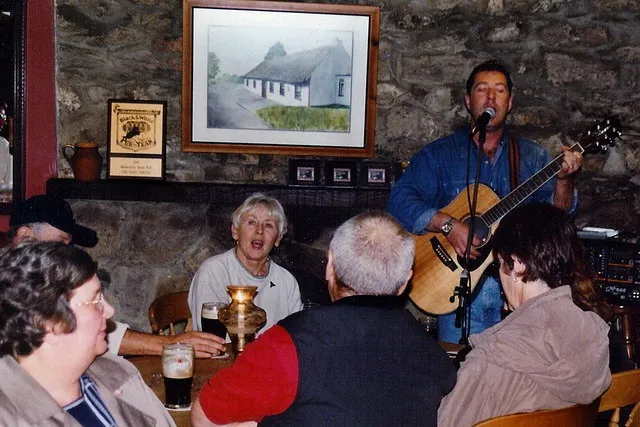
Here is where the cider house earns its keep. The stirring is not a private kitchen task; it is a small ceremony with a queue. Regulars, staff, the person who came in for a quiet half and got talked into a job — everyone gets a turn. We keep the wooden spoon in the bowl and the bowl on a sturdy table near the fire, with a clean cloth and a jug of cider nearby for topping up the mixture and the mood.
The rules are simple. Wash your hands, take the spoon, stir three times clockwise, make a wish, hand it on. Children are welcome and usually take the job very seriously. We leave the old sixpence tradition in the past; a wish is enough, and nobody wants a trip to the dentist. If you are making a pudding at home, the same ritual works in a small kitchen. The point is not the number of people. The point is that the bowl gets passed around.
Steam, Patience, and a Dark Cupboard
When the pudding is cooked, lift it out, let it cool completely and store it somewhere cool and dark. It will sit happily for weeks, and it improves with a little rest. On Christmas Day, steam it again for two hours until it is piping hot all the way through, then turn it out onto a plate. A warm spoonful of brandy is traditional; a warm spoonful of cider is just as good and rather more in keeping with the room.
There is a sustainability argument tucked in here, though it is not the sort that needs a lecture. Buying dried fruit in paper bags, using local cider, reusing the same basin and parchment year after year, composting the trimmings — none of it is dramatic. It is just the quiet good housekeeping that a cider house has always done. A pudding made this way wastes very little and asks very little of the world beyond a bit of time.
A Pour to Keep You Company
While the steaming happens, the bar does what it does best. A half of dry orchard cider is the obvious companion to the bowl, but a glass of perry brings a soft, floral note that sits nicely with the spice. For anyone driving or keeping a clear head, there is a low-alcohol cider or a pot of tea, and neither is a consolation prize. The pudding is not going anywhere. Neither, if we are doing it right, are the people around it.
Good Intentions, Written Down
We keep a small notebook behind the bar for the wishes that get made over the bowl. Some are funny, some are serious, and most are about the same things: health, work, family, a bit of luck. It is not a competition and it is not a performance. It is just a record that on one cold Sunday in November, a room full of people stood round a pudding and thought about someone other than themselves.
That, in the end, is the case for Stir-Up Sunday in a cider house. The pudding is the excuse. The company is the reason. And the best ones — like the best pubs — improve with both.